
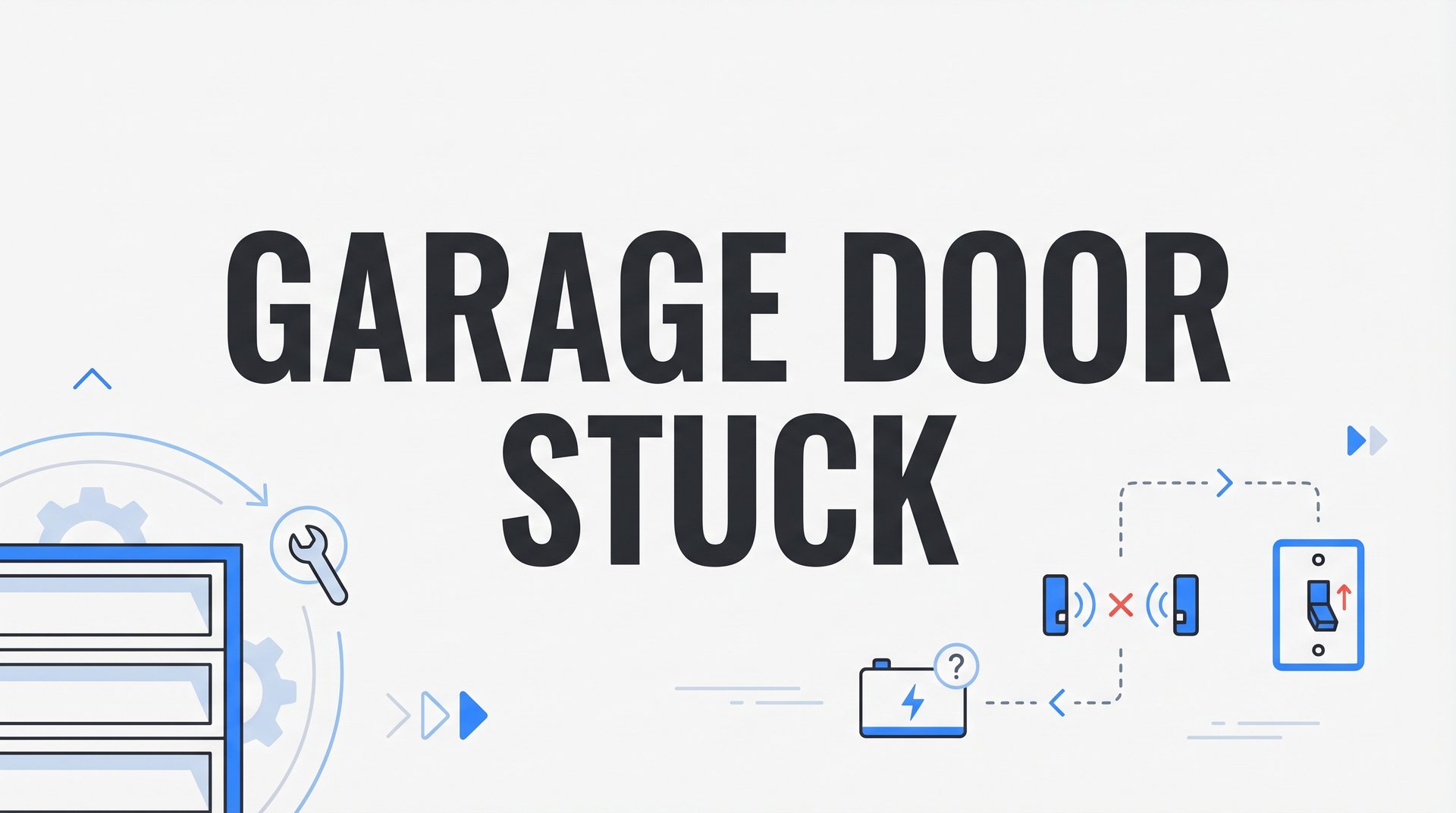
When your garage door stuck in place refuses to budge, the problem often stems from simple fixes like dead remote batteries, misaligned safety sensors, or tripped circuit breakers rather than major mechanical failures. This troubleshooting guide walks homeowners through a systematic approach to diagnose and resolve common garage door issues before calling for professional repairs, potentially saving time and money while getting your door operational again.
You’re already running ten minutes behind schedule when you hit the garage door opener button. Nothing happens. You press it again—still nothing. The door sits stubbornly in place while your car waits inside and your morning plans unravel. Maybe it’s the opposite scenario: you’ve just pulled into your driveway after a long day, eager to get inside, and your garage door absolutely refuses to open. Either way, a stuck garage door doesn’t just disrupt your routine—it can leave your vehicle exposed to Buffalo’s unpredictable weather or trap it inside when you need it most.
Here’s what most people don’t realize: many garage door malfunctions stem from surprisingly simple causes. A dead battery in your remote. A sensor knocked slightly out of alignment by your snow shovel. A circuit breaker that tripped during last night’s storm. Before you assume the worst and brace yourself for an expensive repair bill, there’s a logical sequence of checks you can perform yourself.
This troubleshooting guide takes you through six systematic steps that address the most common reasons garage doors refuse to move. Some of these fixes take less than two minutes. Others help you identify serious problems that genuinely require professional expertise—and knowing the difference matters tremendously for both your safety and your wallet. We’ll show you what to inspect, what you can safely adjust yourself, and exactly when it’s time to step back and call in experienced technicians.
Think of this as your garage door diagnostic checklist. Start at Step 1 and work your way through. You might solve the problem at step two, or you might reach step five before discovering the real culprit. Either way, you’ll understand what’s happening with your door and make informed decisions about next steps.
Step 1: Check the Obvious Culprits First
Before you start examining mechanical components or worrying about complex failures, eliminate the simplest possibilities. Power-related issues cause a surprising number of “stuck” garage doors that have nothing wrong with their actual mechanisms.
Walk over to your garage door opener motor unit—that’s the box mounted to your ceiling with the light and mechanical components. Look for any indicator lights or display panels. If everything appears completely dark and lifeless, you’ve found your first clue. Check whether the unit is actually plugged in. This sounds almost too basic to mention, but power cords get accidentally unplugged more often than you’d think, especially if you’ve recently been working in your garage or moving items around.
Grab your phone charger or a small lamp and plug it into the same outlet your opener uses. Does it work? If not, the problem isn’t your garage door at all—it’s your electrical supply. Head to your home’s circuit breaker panel and scan for any switches in the tripped position. They typically sit slightly offset from the others or rest in a middle position between “on” and “off.” Flip the breaker completely off, then back on again to reset it. Buffalo’s winter storms occasionally cause power surges that trip breakers, particularly if your garage shares a circuit with outdoor outlets.
Now test your remote control. Press the button and watch the motor unit. Nothing? Swap in fresh batteries before assuming anything else is wrong. Those batteries typically last six months to a year, but cold temperatures accelerate their decline. Keep a spare set in your glove compartment for exactly this reason. If you’re still having issues, our guide on troubleshooting your garage door remote covers additional solutions.
Try the wall-mounted control panel inside your garage next. If the wall button works but your remote doesn’t, you’ve isolated the problem to the remote itself—either dead batteries or a programming issue. If neither the remote nor the wall button produces any response whatsoever, and you’ve confirmed the unit has power, you’re dealing with something beyond basic electrical supply.
One more quick check: look for a lock button on your wall control panel. Many modern systems include a vacation lock feature that disables all remote signals to prevent operation while you’re away. It’s usually marked with a padlock icon. If someone accidentally pressed this button, your remotes won’t work even though everything else functions perfectly.
Step 2: Inspect the Photo Eye Sensors
Since 1993, federal safety regulations have required automatic garage door openers to include photo eye sensors that prevent the door from closing on people, pets, or objects. These sensors consist of two small units mounted on either side of your garage door opening, typically about four to six inches above the floor. One sensor sends an invisible infrared beam across the opening; the other receives it. If anything interrupts that beam while the door is closing, the system immediately reverses direction.
These sensors keep your family safe, but they’re also positioned right where they can collect dust, cobwebs, and debris. They’re vulnerable to getting bumped by lawn equipment, bicycles, snow shovels, and all the other items that migrate through your garage. When sensors get dirty or misaligned, your garage door won’t close—or it might start closing then immediately reverse, which feels like being stuck in the open position. For a deeper dive into this issue, check out our complete guide on fixing garage door sensor problems.
Locate both sensor units and examine them closely. Each one should have a small LED indicator light. On most systems, you’ll see a green or red light on each sensor when they’re functioning correctly. If one light is blinking or completely off, you’ve found your problem. The blinking typically indicates the sensors aren’t “seeing” each other properly.
Start with cleaning. Use a soft, dry cloth to gently wipe the lens on each sensor. You’d be amazed how much difference a thin film of dust makes. If you spot stubborn grime, slightly dampen your cloth—but never spray cleaner directly on the sensors. After cleaning, check those indicator lights again.
Still blinking? Now check alignment. The sensors need to point directly at each other to maintain that infrared connection. Kneel down and look along the line between them. Do they appear to aim straight across, or does one point slightly up, down, or off to the side? Even a small misalignment breaks the connection.
Most sensors attach to their mounting brackets with wing nuts or small screws that allow adjustment. Loosen these fasteners slightly—just enough that you can gently move the sensor. While watching the indicator lights, slowly adjust the sensor’s position until both lights become solid instead of blinking. This sometimes requires patience and tiny movements. When you get both lights steady, tighten the mounting hardware to lock the sensors in place.
Buffalo winters add another wrinkle to sensor problems. Snow blown into your garage can accumulate around the sensors. Ice can form on the lenses during extreme cold snaps. If you notice frost or ice on the sensor units, let them warm up naturally or carefully wipe them clean with a dry cloth. Never use heat guns or hot water, as rapid temperature changes can damage the electronics.
One more thing to check: make sure nothing is actually blocking the sensor beam. A broom leaning against the wall, a bag of road salt positioned too close to the door opening, or even a thick cobweb strung between the sensors can trigger the safety system. Clear away anything within a few inches of the sensor path.
Step 3: Examine the Tracks and Rollers for Obstructions
Your garage door travels up and down on a track system—two vertical metal channels that guide the door’s movement and keep it stable. Small wheels called rollers, attached to the sides of your door panels, run inside these tracks. When everything works correctly, this system operates so smoothly you barely notice it. When something goes wrong with the tracks or rollers, your door can jam completely or become dangerously unstable.
Stand inside your garage with the door closed and visually trace both tracks from bottom to top. Look for obvious dents, bends, or warped sections. Garage door tracks are sturdy, but they’re not indestructible. A car bumper backing into a track, heavy equipment knocked against it, or even the cumulative effect of years of vibration can create deformities. Even a small dent can catch a roller and stop your door’s movement entirely.
Check for debris inside the tracks. Leaves, dirt, small stones, and other foreign objects sometimes work their way into the channels. In Western New York, ice buildup becomes a genuine concern during winter months. When temperatures drop, moisture can freeze inside the tracks or around the door’s weatherstripping, essentially gluing your door in place. Our article on checking garage door after Buffalo winter storm provides specific guidance for these situations.
Now examine the rollers themselves. Each door typically has ten to twelve rollers, and you should be able to see most of them when the door is closed. Do they all sit properly inside their tracks, or has one popped out of the channel? Look at the roller wheels—they should appear round and intact, not cracked, chipped, or worn flat on one side. Damaged rollers create friction that makes the door stick or grind during operation. If you’re unsure what to look for, our guide to choosing the best garage door rollers explains the different types and their lifespans.
Pay attention to the roller stems as well. These are the shafts that connect the wheels to the door. If you see a bent stem, that roller won’t travel smoothly through its track. Sometimes a roller becomes loose in its mounting bracket, allowing it to wobble or shift out of position.
Here’s a crucial test: disconnect your door from the opener using the emergency release cord (we’ll cover this in detail in the next step). With the door disconnected, try lifting it manually. It should move relatively smoothly and feel balanced. If the door binds, catches, or feels like it’s fighting you at certain points in its travel, the problem likely involves the tracks, rollers, or related hardware rather than the opener itself.
While you’re examining the tracks, look at the mounting brackets that hold them to your garage walls and ceiling. These brackets should be firmly attached with no loose bolts or screws. A loose track can shift position, causing the door to bind.
One warning: if you discover bent tracks or damaged rollers, resist the urge to grab a hammer and try fixing them yourself. Track repair requires precision—the channels must be perfectly aligned and properly spaced for safe door operation. Rollers need to be replaced with the correct type and properly installed to maintain the door’s balance. These repairs fall into the category of jobs that look simpler than they actually are.
Step 4: Test the Emergency Release and Manual Operation
Every automatic garage door opener includes an emergency release mechanism—typically a red cord with a handle hanging from the opener’s trolley. This safety feature lets you disconnect the door from the opener’s drive system, allowing manual operation during power outages or opener failures. Testing this function tells you whether your problem lies with the opener mechanism or with the door itself.
Before pulling the release cord, make sure your door is in the fully closed position. This matters because of what happens next. When you pull that red handle, you’re disengaging the door from the motor. If the door’s springs are broken or severely weakened, a door in the raised position might come crashing down the moment you disconnect it from the opener. With the door closed, gravity works in your favor.
Pull the emergency release handle straight down. You’ll hear a click or snap as the trolley disconnects from the opener carriage. The door is now in manual mode. Try lifting it. A properly balanced garage door should lift smoothly with moderate effort—roughly equivalent to lifting a heavy suitcase. You shouldn’t need superhuman strength, but you will need to use both hands and put some muscle into it.
If the door lifts easily and stays open when you raise it halfway, your springs are functioning correctly and the door itself moves freely. This tells you the problem almost certainly involves your opener or its connection to the door. If the door feels impossibly heavy—like trying to deadlift a refrigerator—or if it won’t stay open when you lift it partway, you’re dealing with broken or severely weakened springs. Learn more about why high-cycle garage door springs matter for Buffalo homeowners.
Garage door springs are the muscles of the system. They counterbalance the door’s weight, making it possible for the opener motor to lift what would otherwise be hundreds of pounds of dead weight. When springs break, the door becomes extremely heavy and potentially dangerous to operate. Never attempt to use a garage door with broken springs, and absolutely never try to replace springs yourself. These components store enormous tension—enough to cause serious injury or even death if they release unexpectedly during amateur repair attempts.
While the door is disconnected, lower it back down and try lifting it again, this time paying attention to how it feels throughout the entire range of motion. Does it bind or catch at certain points? Does it feel heavier at the bottom than at the top, or vice versa? A door that feels uneven or jerky likely has balance issues that need professional adjustment.
Look at the cables while you’re testing manual operation. These are the steel cables that run from the bottom corners of your door up through pulleys to the springs. They should appear intact with no fraying, rust, or broken strands. If you spot a damaged cable, stop immediately and don’t operate the door further. Cables under tension can whip violently if they break.
To reconnect the door to your opener after testing, simply press your wall button or remote. The trolley will travel along its track, and when it reaches the door’s connection point, you’ll hear it click back into engagement. Some openers require you to manually pull the trolley back to the door before reconnection works.
Step 5: Listen and Look for Opener Motor Issues
Sometimes the door itself works perfectly fine, but the opener motor develops problems that prevent it from doing its job. Your ears and eyes can help diagnose these issues without any tools beyond your senses and a little patience.
Press your wall-mounted control button and listen carefully to what happens. Does the motor hum but the door doesn’t move? That humming sound indicates the motor is receiving power and trying to work, but something prevents it from actually turning the drive mechanism. In many cases, this points to a stripped gear inside the opener. The motor spins, but worn plastic or metal gears can’t grip properly to transfer that rotation to the chain, belt, or screw drive that moves your door.
If you hear clicking sounds instead of humming, the motor might be trying to start but encountering too much resistance. This could mean the drive mechanism is jammed, the door is too heavy due to spring problems, or an internal component has failed. A completely silent motor when you press the button suggests either a power issue (which you checked in Step 1) or a failed motor unit.
Watch the opener’s travel limits in action. These are adjustable settings that tell the motor when the door has reached its fully open or fully closed positions. When limits are set incorrectly, strange things happen. The door might start to close, then immediately reverse as if it hit an obstruction. Or it might try to keep running after the door is already fully open, grinding against the stop bolt. Our detailed guide on adjusting garage door limit switch settings walks you through this process.
Many modern garage door openers include diagnostic features that communicate through blinking LED lights on the motor unit. Check your owner’s manual or look up your opener’s model number online to find the diagnostic code chart. Those blinking patterns aren’t random—they’re telling you exactly what the opener thinks is wrong. You might see codes for sensor problems, motor overheating, limit switch issues, or mechanical obstructions.
Look at the drive mechanism itself—whether your opener uses a chain, belt, or screw drive. Is the chain hanging loosely with excessive slack? A chain should have about half an inch of slack when you push up on it from underneath. Too much slack causes the chain to jump off its sprocket. Too little slack strains the motor. Belt drives should appear tight but not overly taut, with no visible cracks or fraying. Screw drives should turn smoothly without wobbling.
Check the trolley—the piece that connects your opener to the door and travels along the rail. Does it move freely when you manually push it, or does it catch and bind? A binding trolley indicates problems with the rail alignment or the trolley’s wheels.
If your opener is more than ten to fifteen years old and showing multiple symptoms—strange noises, intermittent operation, slow performance—the motor itself might be nearing the end of its service life. Openers don’t last forever, and trying to nurse a failing unit along often costs more in frustration and repeated service calls than investing in a modern replacement with updated safety features and better reliability. Check out our recommendations for the best garage door openers for 2025 if you’re considering an upgrade.
Step 6: Recognize When Professional Expertise Becomes Essential
There’s a clear line between homeowner-friendly troubleshooting and repairs that require professional training, specialized tools, and liability insurance. Crossing that line risks serious injury, property damage, and voiding warranties on your equipment. Knowing when to stop and call for help isn’t admitting defeat—it’s making a smart decision that protects you and your investment.
Broken springs top the list of repairs you should never attempt yourself. If you see a visible gap in a torsion spring (the large spring mounted on the bar above your door) or if your door feels impossibly heavy when you test manual operation, those springs have failed. Some homeowners watch online videos and think spring replacement looks manageable. What those videos don’t convey is the extreme danger involved. Torsion springs store enough energy to break bones, crack skulls, or cause fatal injuries if they release unexpectedly. Professional technicians use specialized winding bars and follow precise procedures to safely manage this tension. The few hundred dollars you might save by attempting DIY spring replacement isn’t worth the risk. For professional help, explore our Buffalo garage door repair services.
Cable problems fall into the same category. If you notice frayed, rusted, or broken cables, don’t touch them and don’t operate the door. Cables work in conjunction with springs and carry tremendous tension. When they fail, they can whip through the air with enough force to cause severe lacerations or worse. Replacing cables requires releasing spring tension first—another reason this job demands professional handling.
Bent or damaged tracks need expert attention as well. While minor cleaning and debris removal are fine for homeowners, actually straightening bent tracks or replacing damaged sections requires precision alignment. Tracks must be perfectly parallel and properly spaced. Even small alignment errors can cause the door to bind, create dangerous stress on components, or lead to complete failure at the worst possible moment.
Damaged door panels or sections present both functional and safety concerns. A dented or cracked panel affects your door’s structural integrity and insulation. Replacing panels involves temporarily supporting the door’s weight, removing specific sections, and ensuring the new panel integrates properly with your door’s balance and operation. Our team can help with broken garage door panels replaced ASAP when you need fast service.
When your opener shows persistent problems despite basic troubleshooting—the motor runs but nothing happens, it works intermittently without pattern, or diagnostic lights indicate internal failures—professional diagnosis makes sense. Technicians have testing equipment that measures motor function, checks electrical systems, and identifies failing components you can’t easily access or evaluate yourself.
Consider the value of professional maintenance even when nothing seems wrong. Annual inspections catch developing problems before they strand you with a stuck door. Technicians lubricate moving parts, test safety features, adjust tension and alignment, and spot worn components that will fail soon. This preventive approach costs less than emergency repairs and extends your system’s lifespan.
Taking Control of Garage Door Problems
Walking through these six troubleshooting steps puts you in control when your garage door refuses to cooperate. You’ve learned to check power sources, clean and align sensors, inspect tracks and rollers, test manual operation, diagnose opener motor issues, and recognize serious problems that demand professional expertise. Many stuck garage doors respond to simple fixes—fresh batteries, realigned sensors, cleared obstructions—that take just minutes to resolve once you know where to look.
The key is approaching the problem systematically rather than randomly trying things and hoping something works. Start with the easiest possibilities and progress toward more complex diagnostics. This methodical approach saves time and helps you communicate clearly with repair technicians when professional help becomes necessary. Instead of saying “my garage door is stuck,” you can explain exactly what you’ve already checked and what symptoms you’ve observed.
Remember the safety boundaries. Some repairs genuinely belong in the hands of trained professionals with proper equipment and insurance. Springs, cables, and major structural issues aren’t worth the risk of DIY attempts. But understanding what’s happening with your garage door—even when you ultimately call for help—makes you a more informed homeowner who can make better decisions about repairs and maintenance.
Keep this guide accessible for future reference. Garage doors will occasionally act up, especially given the demands we place on them and the harsh weather conditions they endure in our region. When problems arise, you’ll know exactly where to start and what to check. Regular maintenance prevents many issues before they develop into full failures, so consider scheduling periodic inspections to keep your system running smoothly year-round.
When troubleshooting reveals problems beyond your comfort level or when you simply want the peace of mind that comes with professional service, learn more about our services. Our experienced technicians handle everything from simple repairs to complete system replacements, always prioritizing your safety and satisfaction.





























 Tap to Call: (716) 608-0053