
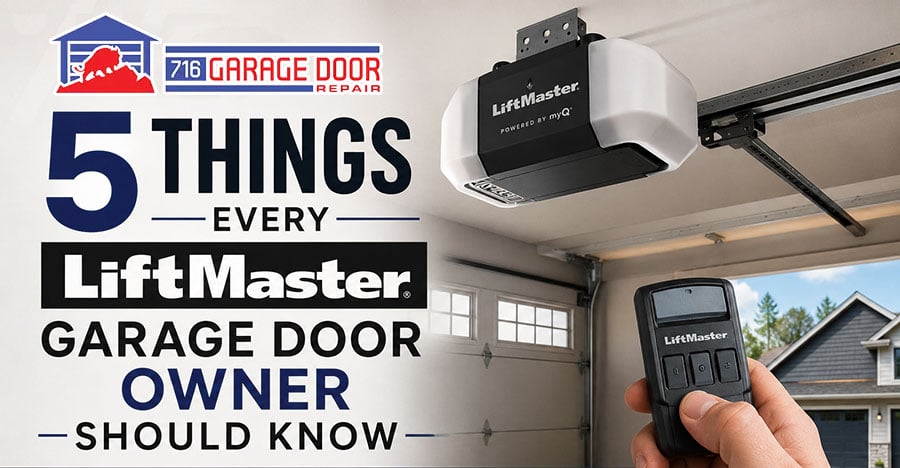
LiftMaster is one of the most popular garage door opener brands in Western New York, and honestly, it’s easy to see why. They’re reliable, well-built, and loaded with features that make daily life a little more convenient. But even the best opener needs some attention, especially when you’re dealing with Buffalo winters, dramatic temperature swings, and the kind of wear that comes from opening and closing your door multiple times every single day.
Whether you just had a LiftMaster installed or you’ve been running the same unit for a decade, there are a few things worth knowing that can save you real time, real money, and a lot of unnecessary frustration. This isn’t a technical manual. It’s just practical advice from a local garage door company that works on these openers regularly across Buffalo, Tonawanda, Rochester, Penfield, Lockport and the surrounding area.
1. Cold Weather Is Hard on Your Opener — Here’s What to Watch For
Buffalo winters are no joke, and your garage door system feels every bit of it. When temperatures drop well below freezing from November through March, the metal components in your door — springs, cables, rollers — get stiff. The bottom seal can freeze to the ground. And your LiftMaster opener, which is designed to lift a properly functioning door, suddenly has to work a lot harder than it should.
The Strategy Explained
Here’s something that surprises a lot of homeowners: LiftMaster openers have a built-in force adjustment that acts as a safety mechanism. If the opener senses too much resistance, it will stop mid-cycle or reverse. This is actually the opener doing its job correctly. But it’s very commonly misdiagnosed as an opener malfunction when the real issue is the door itself — a frozen seal, stiff springs, or dry rollers creating extra drag.
Before assuming your opener is broken, take a minute to manually disengage it and try lifting the door by hand. If it feels heavy, stiff, or uneven, the door is the problem, not the opener. Understanding how Buffalo weather affects your garage door can help you stay ahead of these seasonal issues.
Implementation Steps
1. Every fall, inspect the bottom seal and make sure it’s pliable and making clean contact with the ground — not cracking or hardening.
2. Check that the door moves smoothly by hand before the cold really sets in. Any stiffness in October will only get worse in January.
3. If your opener stops mid-cycle during a cold snap, don’t keep forcing it. Call a technician to assess whether the door or the opener is actually the issue.
Pro Tips
Avoid pouring hot water on a frozen seal to free it — the freeze-thaw cycle can crack the seal and make things worse. A silicone-based lubricant applied to the seal before winter hits is a much better approach and takes about five minutes. Reviewing winter garage door maintenance tips each fall is a smart habit for any Buffalo homeowner.
2. Lubrication Makes a Bigger Difference Than Most People Realize
A noisy, grinding garage door isn’t just annoying. It’s actually putting unnecessary strain on your opener motor every single time the door moves. Over time, that added resistance wears down components faster and shortens the life of your system. Most homeowners don’t think about lubrication until something breaks, but it’s one of the simplest things you can do to protect your investment.
The Strategy Explained
The springs, rollers, hinges, and tracks on your garage door all need periodic lubrication to move freely. When they dry out, friction increases. Your LiftMaster has to work harder to pull or push the door through its full cycle. Do that a few hundred times a year in cold weather, and you’re accelerating wear on the motor and drive system in a way that’s completely avoidable.
The product matters too. A lot of people grab WD-40 because it’s what’s in the garage, but it’s a degreaser, not a lubricant. It can actually strip away the grease that’s already there. Use a dedicated garage door lubricant or a white lithium grease spray instead.
Implementation Steps
1. Lubricate the torsion springs, rollers, and hinges at least once a year — ideally in the fall before temperatures drop.
2. Apply lubricant to the rail and trolley on chain or screw-drive openers (belt drives need less, but the hardware still benefits).
3. Wipe away any excess after application so it doesn’t attract dirt and grit that creates its own friction problems.
Pro Tips
Don’t spray lubricant on the tracks themselves — the tracks need to be clean, not slippery, so the rollers can grip properly. Keep the lubricant on the moving parts, not the surfaces they travel along.
3. The Safety Sensors Are Doing More Than You Think
If your garage door reverses immediately when you try to close it, or the light on your opener is blinking in a pattern, there’s a good chance the safety sensors are involved. Sensor issues are one of the most common service calls we see across Western New York, and the good news is that it’s often something a homeowner can diagnose themselves before picking up the phone.
The Strategy Explained
LiftMaster’s safety sensors sit near the bottom of the door on each side, sending an invisible beam across the opening. If anything interrupts that beam, the door won’t close. This is a critical safety feature, especially in homes with kids and pets. But the sensors are also small, low to the ground, and easy to knock out of alignment. A stray soccer ball, a broom handle, or even a garbage bag brushing against the bracket can shift them just enough to break the beam.
When sensors are misaligned, one of them will typically show a steady light and the other will flicker or go dark. That’s your signal. The fix is usually just carefully adjusting the bracket back into position until both lights are solid and steady. For a deeper walkthrough, our guide on fixing garage door sensor problems covers the full process step by step.
Implementation Steps
1. Look at both sensor units — one should have a steady amber light (sending) and the other a steady green light (receiving). A blinking or dark light means something’s off.
2. Check for any obvious obstructions in the door’s path first. Cobwebs, a bag of mulch, a box near the door — all of these can trigger the sensors.
3. If the path is clear but lights are still off, gently loosen the wing nut on the misaligned sensor, reposition it until the light goes solid, and retighten.
Pro Tips
If both sensors look aligned and the lights are steady but the door still won’t close, the sensor wiring may be damaged or there may be a different issue at play. That’s when it’s worth calling a technician rather than guessing.
4. When Your LiftMaster Starts Acting Up, Springs Are Often the Real Culprit
This is probably the most misunderstood thing about garage door openers in general. When a LiftMaster starts struggling, reversing unexpectedly, or seems like it’s straining to lift the door, most homeowners assume the opener is failing. But in a large number of cases, the opener is actually fine. The problem is the springs.
The Strategy Explained
Your garage door opener is designed to operate a door that’s properly balanced and counterweighted by its springs. The springs do most of the heavy lifting — the opener just guides the door through its cycle. When a spring loses tension or breaks entirely, the door becomes dramatically heavier. Your LiftMaster will try to compensate, but it’s not built to carry that load. That’s when you start hearing straining noises, seeing slow movement, or getting mid-cycle reversals.
Forcing the opener to keep working with a compromised spring doesn’t just risk damaging the opener — it can also damage the trolley, the rail, and other hardware. What might have been a straightforward spring repair in Buffalo turns into a more expensive multi-component job.
Implementation Steps
1. If your door feels heavier than usual when you lift it manually, or it doesn’t stay open on its own when raised halfway, suspect a spring issue.
2. Look at the torsion spring above the door (or the extension springs on the sides) for any visible gaps, separation, or obvious breakage. Homeowners in Cheektowaga and surrounding communities deal with this more often than they’d expect after harsh winters.
3. Stop using the opener if you suspect a broken spring. Continued use can cause real damage. Call a professional for spring repair — this is not a DIY job.
Pro Tips
Torsion springs are under significant tension and should only be adjusted or replaced by a trained technician. The risk of injury from a mishandled spring is serious. If you’re not sure, err on the side of caution and get a professional assessment. You can also learn more about high-cycle garage door springs and whether they’re a smart upgrade for your home.
5. Knowing When to Repair vs. Replace Your Opener
At some point, every opener reaches the end of its useful life. The question most homeowners struggle with is whether they’re at that point or whether a repair still makes sense. Spending money on repairs for an opener that’s on its last legs isn’t a great investment, but neither is replacing something that has years of life left in it.
The Strategy Explained
LiftMaster openers are well-built and can last many years under normal use. But heavy use, deferred maintenance, and harsh winters like those we see in Western New York can shorten that lifespan. When an opener starts showing multiple symptoms at once — slow response, grinding noises, intermittent operation, or visible wear on the drive system — that’s usually a sign that repairs are becoming a recurring cost rather than a one-time fix.
On the other hand, if your opener is relatively recent and well-maintained, a single repair is almost always worth it. The key is being honest about the pattern. One repair in five years is normal maintenance. Three repairs in one year is a different story. Our detailed breakdown on when you actually need a new garage door opener can help you make that call with confidence.
Implementation Steps
1. Consider the age of the unit and the history of repairs. If you’ve been patching the same opener repeatedly, the math on replacement often starts to make sense.
2. Watch for grinding or rattling from the drive mechanism, sluggish or inconsistent response to the remote, and the opener running but the door not moving.
3. Ask a technician for an honest assessment — a good local company will tell you if repair is the right call rather than pushing for a replacement you don’t need.
Pro Tips
If you do decide to replace, it’s worth considering an upgrade to a LiftMaster model with MyQ connectivity. Browse the LiftMaster garage door opener catalogue to compare models and features. The WiFi-based remote access is genuinely useful, though keep in mind that connectivity hiccups are almost always router or WiFi-related rather than a hardware problem with the opener itself.
Keeping Your LiftMaster Running Well for the Long Haul
Most garage door problems don’t come out of nowhere. They build gradually — a little more friction here, a little more strain there — until something finally gives. The good news is that a LiftMaster opener, properly maintained and paired with a healthy door, is a system that can serve you reliably for a long time even in a tough climate like ours.
The five things covered here aren’t complicated. They’re just the kind of practical knowledge that helps you catch problems early, avoid unnecessary repairs, and get the most out of what you’ve already got.
If you’re in Rochester, Penfield, Lockport, Buffalo, Tonawanda, or anywhere across Western New York and your LiftMaster is acting up, making noise, or you just want a tune-up before winter hits, we’re happy to take a look. We’re locally owned, we give you straight answers, and we’re not going to recommend work you don’t need. Scheduling online is easy!






















 Tap to Call: (716) 608-0053