

You hit the button to close the garage, the door starts moving, then suddenly reverses. You glance down and spot a blinking light on one of those little sensors near the floor. Now what? Is something broken? Is it safe to use the door?
Take a breath. This is one of the most common calls we get from homeowners across Western New York, and the good news is it’s usually something simple. Blinking sensor lights look alarming, but they’re actually the door’s built-in way of telling you something specific. Here’s what’s going on and how to sort it out.
What Are Garage Door Sensors, and Why Do They Have Lights?
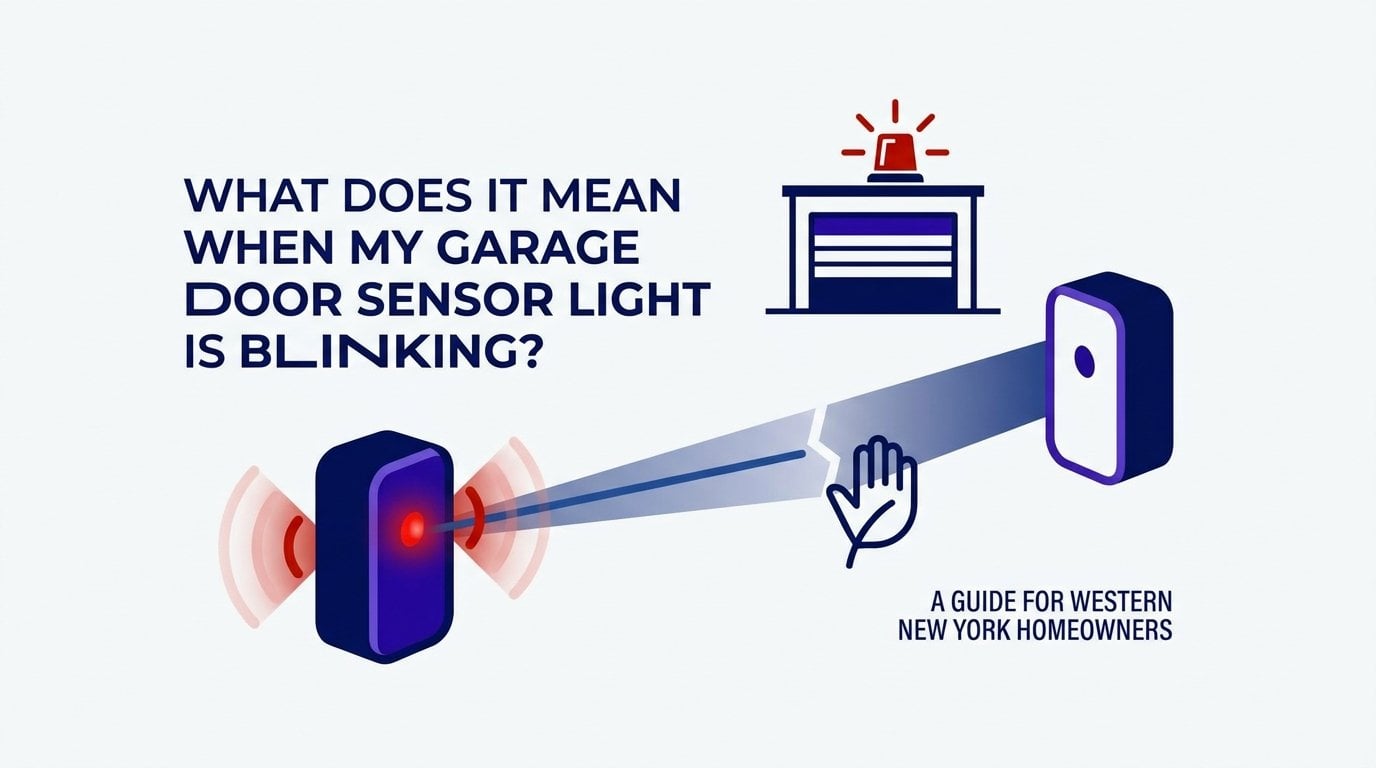
Those two small devices mounted near the bottom of your door tracks are called photo-eye sensors, or safety sensors. One side sends an invisible infrared beam across the opening; the other side receives it. If anything breaks that beam while the door is closing, the opener stops and reverses. It’s a safety feature required on all residential garage door openers manufactured after 1993 under UL 325 standards.
The lights tell you what’s happening with that beam at a glance. The sending sensor (usually on one side) has an amber or yellow light that stays steady whenever it’s powered on. The receiving sensor on the opposite side typically shows a green light when it’s locked onto the beam properly.
A blinking light isn’t a malfunction in itself. It’s the system flagging that something is off with the beam connection. Think of it as a check-engine light for your door’s safety circuit. It’s doing its job by alerting you before something goes wrong.
Why Is the Sensor Light Blinking? What’s Actually Happening?
There are a few culprits that show up again and again, and most of them are pretty easy to identify.
Misalignment: This is the most frequent cause. The sensors need to point directly at each other to maintain the beam. A bike leaning against the track, a trash can bumped into the sensor, or even a kid’s soccer ball rolling through the garage can knock one slightly off-angle. It doesn’t take much. Even a few degrees of shift can break the signal entirely.
Something in the beam path: A fallen leaf, a cobweb stretched across the opening, dust on the lens, or even a bug sitting on the sensor face can interrupt the signal. It sounds minor, but the sensors are sensitive enough that it genuinely matters.
Wiring problems: This one is more common in older Buffalo-area homes with unheated garages. The wiring that runs along your door tracks can fray, get pinched by the track, or corrode over time, especially with the moisture and temperature swings we deal with in Western New York. Intermittent wiring issues often show up as a blinking sensor light that comes and goes.
Can You Fix a Blinking Sensor Light on Your Own?
Often, yes. Start with the basics before assuming anything is seriously wrong.
First, look for anything blocking the beam path between the two sensors. Remove it, then try closing the door. If that doesn’t do it, grab a dry cloth and gently wipe both sensor lenses clean. Dust and moisture film are surprisingly effective at disrupting the signal.
If the light is still blinking, check alignment. Look at the receiving sensor’s light. If it’s blinking or not lit at all, the beam isn’t connecting. Most sensor brackets are held by a simple wing nut. Loosen it slightly, nudge the sensor until the light goes solid, then tighten it back up. It usually takes less than a minute once you know what you’re doing.
If cleaning and realigning don’t resolve it, take a look at the wiring running along the door tracks. Visible fraying, chewed insulation (rodents are a genuine issue in WNY garages), or loose connections at the sensor or opener are signs it’s time to call a technician rather than keep troubleshooting on your own.
Does Buffalo’s Cold Weather Actually Affect Garage Door Sensors?
It does, more than most homeowners realize. Metal sensor brackets expand and contract with temperature changes, and Western New York’s freeze-thaw cycles are significant. What’s perfectly aligned in October can drift slightly out of position by January, which is why alignment issues tend to spike in late fall and again as things warm up in spring.
Moisture is another factor. Ice and condensation can fog up sensor lenses or accelerate corrosion in wiring connections, particularly in garages that aren’t climate-controlled. If your garage sits at 5°F for weeks at a time, those connections take a beating.
Quality systems like Hörmann’s SupraMatic opener line are engineered with weather resistance in mind, and their integrated sensor setups hold up well in harsher climates. That said, even well-built components benefit from a quick check each season, especially before winter sets in.
When Should You Skip the DIY and Call Someone?
If you’ve cleaned the lenses, realigned the sensors, and the light is still blinking after a few minutes of troubleshooting, stop there. A technician can quickly identify whether the issue is a wiring fault, a problem with the opener’s logic board, or something else entirely. Continuing to guess can sometimes make things worse.
More importantly: if your door is reversing on its own or refusing to close, don’t bypass the sensors to force it shut. That safety system exists to prevent serious injuries. Holding the wall button to manually override it is only appropriate in a genuine pinch, not as a daily workaround.
Sensor replacement is typically quick and affordable. There’s no reason to put up with a door that won’t cooperate when the fix is usually straightforward.
Quick Answers to Common Sensor Questions
Why does the sensor blink at night but work fine during the day? This is almost always sunlight interference. Direct sun hitting the receiving sensor in the afternoon can overwhelm it, causing it to lose the signal temporarily. Repositioning the sensor slightly or adding a small shade can help.
Can I still use the door if the sensor light is blinking? You can hold the wall button to force it closed, but this bypasses the safety system. It’s not something to rely on regularly.
How long do sensors typically last? With basic maintenance and annual alignment checks, sensors can last many years. Wiring tends to be the first thing to show wear, especially in unheated garages.
Still Blinking? Let’s Take a Look
A blinking sensor light is one of those things that looks worse than it usually is. Most of the time, a quick clean and a minor adjustment is all it takes. But if you’ve worked through the basics and your door still won’t cooperate, that’s what we’re here for.
716 Garage Door Repair works with homeowners across Buffalo, Tonawanda, and all of Western New York. We’re a locally owned team, and we know exactly what these garages deal with through a WNY winter. Give us a call and we’ll get it sorted out quickly. Scheduling online is easy!





























 Tap to Call: (716) 608-0053