
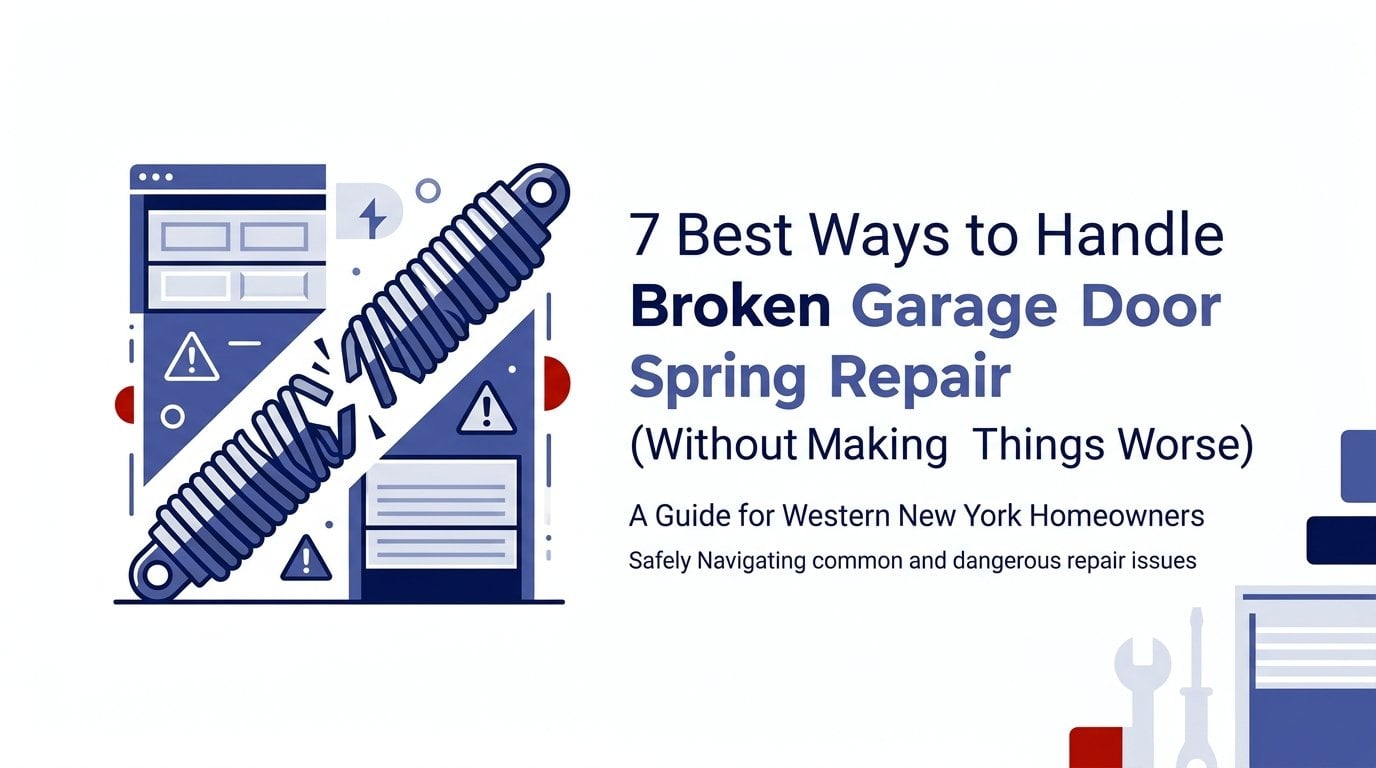
If your garage door suddenly dropped, won’t open, or made a loud bang in the middle of the night, there’s a good chance you’ve got a broken spring. It’s one of the most common calls we get here in Western New York, especially after a long winter when the cold has been cycling springs through thousands of open-and-close movements day after day.
The good news: broken spring repair is very fixable. The not-so-good news: it’s also one of the more dangerous DIY repairs a homeowner can attempt. Springs store an enormous amount of tension, and that energy has to go somewhere when things go wrong.
This article walks through the smartest ways to handle a broken garage door spring, from recognizing the problem early to knowing when to step back and call a pro. Whether you’re in Buffalo, Lockport, Rochester, or anywhere across Western New York, these tips will help you handle the situation safely and get your door back on track as fast as possible.
1. Know What a Broken Spring Actually Looks Like
The Challenge It Solves
A lot of homeowners don’t realize the spring is the problem. They assume the opener is broken, the tracks are jammed, or something is wrong with the remote. Misdiagnosing the issue leads to wasted time, unnecessary calls, and sometimes making things worse before getting help.
The Strategy Explained
There are two types of springs on residential garage doors: torsion springs, which run horizontally above the door opening, and extension springs, which stretch along the horizontal tracks on either side. Both can break, and both give you clear signs when they do.
The most dramatic sign is a loud bang, often described as a gunshot or something falling in the garage. That’s the spring releasing its tension all at once. After that, you might notice the door won’t budge, hangs noticeably lower on one side, or has a cable that’s gone completely slack and coiled on the ground. If you look at the torsion spring above the door and see a visible gap in the coil, that’s your answer right there.
Implementation Steps
1. Look at the spring above the door opening. A torsion spring with a gap in the middle has snapped.
2. Check the cables on both sides. A slack or fallen cable usually means the spring on that side has given out.
3. Try lifting the door manually with the opener disconnected. A spring-dead door will feel extremely heavy, far heavier than normal.
Pro Tips
Don’t spend too long investigating. Once you’ve confirmed a broken spring, the next step is leaving the door where it is and calling for service. Poking around the spring mechanism isn’t something to do out of curiosity.
2. Don’t Try to Force the Door Open
The Challenge It Solves
The instinct is understandable. You need to get your car out, you’re running late, and the door just won’t cooperate. But forcing a door with a broken spring is one of the fastest ways to turn a straightforward repair into an expensive one.
The Strategy Explained
When a spring breaks, the door’s full weight, which can be anywhere from 150 to over 400 pounds on a typical residential door, is no longer counterbalanced. Your opener motor was never designed to lift that alone. Running the opener anyway can burn out the motor or strip the gears inside the unit. Manually forcing the door up can bend panels, pull cables off the drum, or damage the tracks.
In older Buffalo-area homes especially, where heavier wood or solid steel doors are common, this risk is even higher. Those doors are genuinely heavy, and the hardware takes a beating when the spring isn’t doing its job.
Implementation Steps
1. Disconnect the opener immediately if the spring has broken. Do not run it.
2. Leave the door in the closed position if at all possible. It’s safer to have it down than partially open.
3. If you absolutely need vehicle access, call a technician first. A pro can safely manage the door manually without causing additional damage.
Pro Tips
If your car is stuck inside, let the repair company know when you call. Most can prioritize same-day service for situations like this, and it’s much easier than dealing with a burned-out opener motor on top of everything else.
3. Understand Why Springs Break in Western New York
The Challenge It Solves
Springs don’t just break randomly. There are real mechanical reasons behind it, and understanding them helps homeowners make smarter decisions about repairs and replacements going forward.
The Strategy Explained
Metal expands and contracts with temperature changes. In Western New York, where lake-effect cold can bring sharp temperature swings over just a few days, springs go through that stress cycle repeatedly across a long winter season. Each open-and-close movement adds to the fatigue. Over time, the metal weakens at stress points and eventually gives way.
This is why spring failures tend to spike in late fall and early winter, right when temperatures drop sharply. The spring was already worn from the warmer months, and then the cold hits and accelerates the process. It’s not bad luck. It’s physics.
Homes with heavier doors and households that use the garage as their primary entrance also go through spring cycles faster. A family that opens and closes the garage door six or eight times a day will wear through a standard spring much sooner than someone who uses it twice.
Implementation Steps
1. Think about how often your door gets used daily. High-use households should factor this into replacement decisions.
2. Pay attention to the season. If your spring is getting older and it’s heading into a WNY winter, a proactive inspection is worth scheduling.
3. Ask your technician about the age and condition of both springs, not just the one that broke.
Pro Tips
Springs often come in pairs. If one breaks, the other is usually at a similar wear point. Many homeowners choose to replace both at the same time to avoid a second service call a few months later.
4. Skip the DIY — Here’s Why Spring Repair Is Genuinely Dangerous
The Challenge It Solves
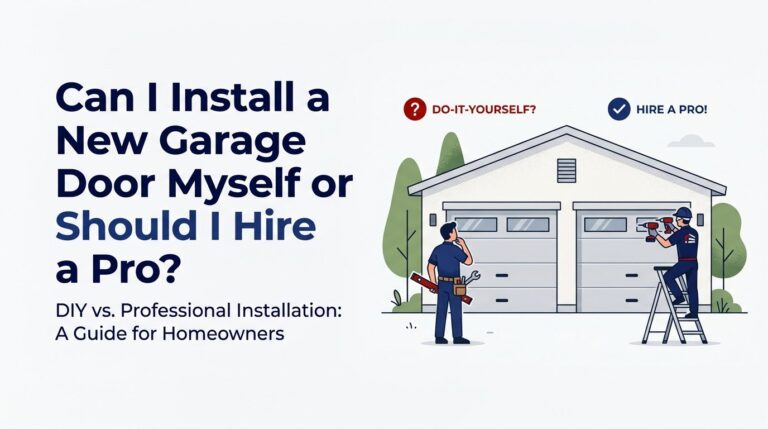
There’s no shortage of DIY garage door videos online, and plenty of homeowners are capable of handling basic repairs around the house. Spring replacement is a specific exception, and it’s worth being honest about why.
The Strategy Explained
Torsion springs are wound under extreme tension using specialized winding bars. The process requires controlled, precise movements. If a bar slips, if the spring is mishandled, or if the wrong size spring is installed, the release of energy can cause serious injury. This is a well-established safety concern in the garage door industry, not an exaggeration to scare people away from DIY work.
Extension springs carry their own risk. They run along the horizontal tracks and should have safety cables threaded through them. If those cables are missing or worn and the spring snaps, it can fly across the garage with significant force. Even with safety cables in place, replacing extension springs requires knowing how to properly re-tension and balance the door afterward.
Beyond the safety issue, there’s the practical one: an improperly installed spring puts uneven stress on the door, the opener, and the hardware. You may fix the immediate problem and create three more.
Implementation Steps
1. Do not purchase replacement springs and attempt installation without professional training.
2. If you’re handy and curious, focus your energy on the maintenance tasks that are genuinely safe for homeowners, like lubrication and visual inspections.
3. Call a licensed garage door technician for any spring work, period.
Pro Tips
A professional spring replacement typically takes under an hour. The time savings alone, compared to researching, sourcing parts, and attempting a repair yourself, usually makes the service call the more practical choice.
5. What to Expect When a Pro Shows Up
The Challenge It Solves
A lot of homeowners feel anxious about service calls because they don’t know what’s going to happen, what’s going to be found, or what it’s going to cost. Walking through the process takes the mystery out of it.
The Strategy Explained
A typical spring repair visit starts with a quick assessment of the door: the technician will confirm which spring or springs broke, check the cables, look at the drums and bearings, and take note of the door’s overall condition. This isn’t about upselling. It’s about making sure the repair holds and the door is safe to use afterward.
Once the broken spring is identified, the tech will measure and install the correct replacement. Springs are sized by wire diameter, inside diameter, and length, and getting the right spec matters for how the door balances. After installation, the door gets tested for balance and smooth operation. If the opener has any obvious strain from running without proper spring support, that gets noted too.
At 716 Garage Door Repair, we believe in transparent pricing. You’ll know what the repair costs before any work starts, and there won’t be surprises on the invoice.
Implementation Steps
1. When you call, describe what happened: the bang, the crooked door, the slack cable. This helps the technician come prepared with the right parts.
2. Be available to walk through the door with the tech so you understand what was found and what was done.
3. Ask about the warranty on the new spring and the labor.
Pro Tips
Most spring repairs can be completed the same day. If you call in the morning, there’s a good chance your door is working again by afternoon.
6. Consider Upgrading to High-Cycle Springs While You’re At It
The Challenge It Solves
Standard springs are rated for a certain number of open-and-close cycles. For households that use their garage door heavily, those cycles get used up faster than expected. Since the door is already being serviced, this is a natural moment to think about a longer-lasting option.
The Strategy Explained
High-cycle springs are built with heavier-duty wire and are rated to last significantly longer than standard residential springs. For a household that uses the garage as the main entry point, multiple times a day, every day, the upgrade can mean years of additional life before the next replacement is needed.
The upfront cost is higher than a standard spring, but when you factor in the labor cost of a future service call, the math often works in favor of the upgrade. It’s especially worth considering if you have a heavier door, if you’ve already replaced springs more than once, or if you’re planning to stay in the home for several more years.
Implementation Steps
1. Ask your technician what cycle rating the current springs were and how that compares to high-cycle options.
2. Think honestly about how often your door gets used. A household that opens the garage door eight or ten times a day is a strong candidate for the upgrade.
3. Get the cost difference explained clearly so you can make an informed decision without pressure.
Pro Tips
If you’re replacing one spring anyway, replacing both with high-cycle springs at the same time is usually the most cost-effective approach. You avoid a second service call and both springs age at the same rate going forward.
7. Prevent the Next Breakage With Simple Maintenance
The Challenge It Solves
Springs don’t last forever, but how long they last is influenced by how well the door is maintained. A few simple habits can extend spring life and give you early warning before something breaks completely.
The Strategy Explained
Lubrication is the most important and most overlooked part of garage door maintenance. Springs, hinges, rollers, and cables should be lubricated with a proper garage door lubricant, not WD-40, a couple of times a year. In Western New York, where winters are long and temperatures fluctuate significantly, doing this in late fall before the cold sets in and again in early spring is a reasonable rhythm.
Beyond lubrication, listen to your door. A spring that’s wearing out often starts making noise: squeaking, grinding, or a slight popping sound during operation. The door may also start to feel slightly uneven or slower than usual. These are early signals worth paying attention to.
An annual tune-up from a local garage door company is also worth scheduling. A technician can spot a spring that’s getting close to the end of its life before it fails, which gives you the option to replace it on your schedule rather than on the spring’s schedule.
Implementation Steps
1. Apply a proper garage door lubricant to the springs, hinges, rollers, and cables twice a year.
2. Do a quick visual check every few months. Look for rust, gaps in the spring coil, or fraying on the cables.
3. Schedule an annual inspection with a qualified technician, ideally before winter arrives.
Pro Tips
If your door is more than ten years old and you’ve never had the springs inspected, that’s a good enough reason to book a maintenance visit. Catching a worn spring before it breaks is almost always cheaper and less disruptive than dealing with the repair after the fact.
Getting Your Door Back on Track
A broken spring doesn’t have to mean a bad day. Most repairs can be completed the same day by a qualified technician, and once it’s done right, the door will feel better than it has in years.
If you’re dealing with a broken spring right now, or just want someone to take a look before winter hits, 716 Garage Door Repair serves homeowners and businesses across Buffalo, Lockport, Rochester, and all of Western New York. We’re locally owned, we show up when we say we will, and we won’t leave you guessing about what anything costs.
Give us a call and we’ll get your door sorted out. Scheduling online is easy!






























 Tap to Call: (716) 608-0053