
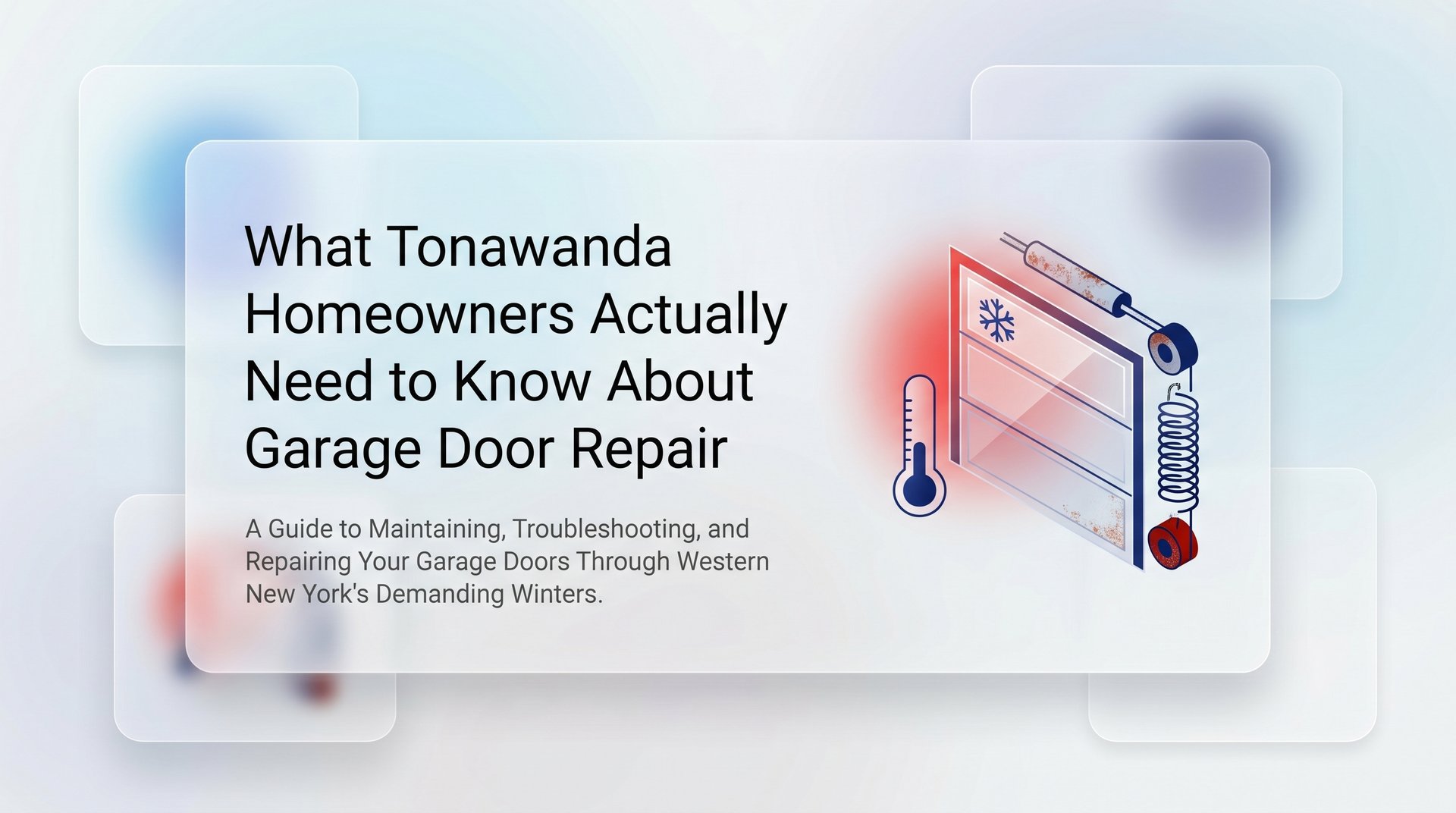
Garage door repair in Tonawanda, NY presents unique challenges due to lake effect snow, extreme freeze-thaw cycles, and road salt corrosion that accelerate wear on springs, cables, and rollers. This guide covers what local homeowners with older homes specifically need to know to maintain, troubleshoot, and repair their garage doors through Western New York‘s demanding winters.
If you’ve ever walked out to your garage on a January morning in Tonawanda and found the door frozen solid to the ground, you already know what this article is about. That particular frustration — standing there in the cold, late for work, yanking on a door that won’t budge — is something homeowners in milder climates genuinely never experience. But around here, it’s practically a winter tradition.
Tonawanda sits right in the lake effect snow belt off Lake Erie. That means repeated storms, brutal temperature swings, and the kind of freeze-thaw cycles that quietly destroy garage door hardware season after season. Add in the road salt that drifts into garages from nearby streets, and you’ve got conditions that chew through rollers, springs, cables, and weatherstripping faster than most people expect.
The older neighborhoods don’t make it any easier. A lot of homes in Tonawanda were built between the 1940s and 1970s, and many of those detached garages are still running on door systems that have seen decades of Erie County winters. Rusted hardware, worn-out seals, and springs that are long past their useful life are the norm, not the exception.
This article is a practical, no-nonsense look at what Tonawanda homeowners actually need to know about garage door repair. Not generic advice you’d find anywhere — specific guidance shaped by what happens to garage doors in Western New York. The team at 716 Garage Door Repair works these neighborhoods regularly, and what follows reflects the real issues we see on these streets every season.
1. Understand What Tonawanda’s Climate Does to Your Door
The Challenge It Solves
Most garage door problems in Tonawanda don’t happen overnight. They build up slowly, season after season, as the local climate chips away at every component in the system. If you don’t understand what the weather is actually doing to your door, you end up reacting to failures instead of preventing them.
The Strategy Explained
Lake effect snow brings heavy, wet precipitation that saturates door seals and pools at the base of the door. When temperatures drop — and in Tonawanda, they can drop fast — that moisture freezes. The freeze-thaw cycle repeats dozens of times each winter, expanding and contracting metal components, cracking rubber seals, and working hardware loose over time.
Road salt is the other major factor. Sodium chloride and calcium chloride are used heavily on Tonawanda streets, and that salt doesn’t stay on the road. It gets tracked in, blown in, and eventually settles on your door’s springs, cables, rollers, and tracks. Salt accelerates metal corrosion significantly, and on older detached garages with uncoated hardware, you’ll often see rust forming within just a few winters.
Temperature swings also cause wood door panels and older door frames to swell and shrink. A door that operates smoothly in October might bind and stick by February, not because anything broke, but because the materials shifted with the temperature. Understanding these patterns is key to effective garage door maintenance in our region.
Implementation Steps
1. Walk your garage door through a visual inspection each fall before the first snowfall — look for surface rust on springs and cables, cracks in weatherstripping, and any hardware that looks loose or corroded.
2. After heavy lake effect events, clear snow and ice from the base of the door and the track area before attempting to operate the door.
3. Note any changes in how the door sounds or moves as temperatures drop. Early changes in behavior are your best early warning system.
Pro Tips
Pay extra attention to detached garages. They’re less insulated, experience more dramatic temperature swings, and often have older hardware that was never designed to handle decades of Western New York winters. If your detached garage is original to a home built before 1980, assume the hardware is overdue for inspection.
2. Diagnose Noisy Door Sounds Before They Become Failures
The Challenge It Solves
A lot of homeowners tune out garage door noise. The door’s always made that sound, they figure. But grinding, popping, and squealing are your door system talking to you, and in cold weather, those sounds often mean something is close to failing. Catching it early is always cheaper and safer than waiting for a complete breakdown.
The Strategy Explained
Different sounds point to different problems. A grinding noise typically means rollers are worn or the track has debris in it. Squealing often points to rollers or hinges that need lubrication — and in cold weather, lubricant thickens and stops doing its job, so this is especially common in January and February. A popping or banging sound during operation can indicate a spring that’s under uneven tension or a cable that’s starting to slip.
Cold temperatures make all of these worse. Metal contracts, lubricants stiffen, and components that were borderline in fall become genuinely problematic by midwinter. A door that squeals a little in October might be grinding badly by January if nothing is done. Our complete guide to fixing common problems covers many of these scenarios in detail.
The key is to pay attention when the sounds change. A new noise, or a familiar noise that’s getting louder, is a signal worth acting on.
Implementation Steps
1. Run your door up and down slowly and listen carefully at different points in the travel — the sound may only appear at a specific spot in the track, which helps narrow down the cause.
2. Apply a garage door-specific lubricant (not WD-40, which is a solvent) to rollers, hinges, and the spring. Do this in fall before temperatures drop and again mid-winter if sounds return.
3. If you hear a sharp bang or pop, stop using the door and call a professional. That sound can indicate a spring or cable that’s about to fail.
Pro Tips
Use a lubricant rated for cold temperatures. Standard lubricants can thicken and become ineffective below freezing, which is exactly when you need them most. A silicone-based or lithium grease product designed for cold climates will hold up better through a Tonawanda winter.
3. Thaw a Frozen Door Safely Without Damaging It
The Challenge It Solves
Forcing a frozen garage door is one of the most common ways homeowners cause serious damage. When the bottom seal freezes to the ground, the door won’t move — and if you hit the opener button anyway, you risk snapping the cables, stripping the opener, or tearing the bottom seal entirely. Knowing how to handle a frozen door properly saves you from an expensive repair call.
The Strategy Explained
The door freezes because moisture collects at the base and then solidifies overnight. This happens most often after a snow event followed by a sharp temperature drop, which is a pattern Tonawanda sees regularly throughout the winter. The seal bonds to the concrete or asphalt below it, and the door is effectively stuck.
The safe approach is to break that bond gently before trying to operate the door. A heat gun or hair dryer applied along the bottom seal works well. You can also use a de-icing product on the threshold, though avoid anything with high salt content directly on the seal, since that accelerates rubber cracking over time. In a pinch, warm water poured carefully along the base can work, but you need to dry it quickly so it doesn’t refreeze.
Never chip at ice with a sharp tool near the seal. You’ll cut the rubber, and then you’re replacing the seal anyway. Forcing the door can also knock it off its tracks, leading to a costly garage door off track repair.
Implementation Steps
1. Before forcing the opener, check whether the door is frozen by trying to lift it manually a few inches. If it won’t budge, assume it’s frozen and treat it accordingly.
2. Apply gentle heat along the bottom seal using a heat gun or hair dryer until the bond releases. Work slowly and evenly rather than concentrating heat in one spot.
3. After thawing, apply a silicone-based lubricant or a threshold seal treatment to the bottom of the door to reduce the chance of it freezing again.
Pro Tips
A rubber threshold seal installed on the garage floor can help prevent this problem entirely. It creates a tighter seal that’s less likely to bond with ice, and it also keeps out the cold air and moisture that damage the rest of the door system. It’s a relatively inexpensive fix that pays off every winter.
4. Leave Spring Repairs to a Professional — Always
The Challenge It Solves
Torsion springs are the most dangerous component on a residential garage door. They’re wound under enormous tension, and when they fail — which happens more often in cold climates — the release of that energy can cause serious injury. This is not a repair for homeowners, ever. Understanding why matters as much as knowing what to do.
The Strategy Explained
Standard torsion springs are typically rated for around 10,000 open-close cycles. Cold weather accelerates metal fatigue, meaning springs in Western New York often reach the end of their lifespan faster than the same spring would in a warmer climate. The repeated contraction and expansion from freeze-thaw cycles stresses the metal at a microscopic level, and eventually it gives out.
When a spring snaps, it usually happens fast and loud. You’ll hear a sharp bang, and the door will suddenly feel extremely heavy or won’t open at all. At that point, the opener is doing all the work the spring was designed to handle, and running it that way risks burning out the motor. This is when you need 24/7 emergency garage door repair service.
The International Door Association and virtually every professional in the industry agrees: spring replacement requires specialized tools, training, and knowledge of how to safely release and reset tension. A mistake during DIY spring repair can result in the spring releasing violently. This is one of those repairs where calling a professional isn’t optional — it’s the only reasonable choice.
Implementation Steps
1. If you hear a loud bang and your door suddenly won’t open or feels extremely heavy, stop using the opener immediately and disconnect it.
2. Do not attempt to manually operate a door with a broken spring — it can fall and cause injury or damage.
3. Call a local garage door repair company for same-day or emergency service. Spring repair is one of the most common calls we handle, and a professional can typically have it resolved within an hour or two.
Pro Tips
Ask about upgrading to a higher-cycle spring when you replace. Springs rated for 20,000 or 30,000 cycles cost more upfront but last significantly longer, which matters in a climate like Tonawanda’s where the hardware is under more stress than average.
5. Inspect Cables Seasonally for Fraying and Corrosion
The Challenge It Solves
Cables don’t get as much attention as springs, but they fail too — and in Tonawanda, they fail faster than they should because of the salt and moisture environment. A fraying cable is a ticking clock. Catching it before it snaps keeps your door operating safely and prevents the kind of sudden failure that leaves your car trapped inside.
The Strategy Explained
Garage door cables run along the sides of the door and work in tandem with the springs to control the door’s movement. They’re made of braided steel wire, which is strong but not immune to corrosion. In an environment with road salt in the air and repeated moisture exposure, the outer strands of the cable can begin to rust and fray, weakening the overall cable over time.
You’ll often see this first at the bottom of the cable where it attaches to the drum or the bottom bracket — areas where moisture collects and salt accumulates. For Tonawanda homeowners specifically, our guide on garage door cable replacement in Tonawanda covers this issue in depth.
A snapped cable typically causes the door to hang at an angle or drop suddenly on one side. That’s a significant safety hazard, and it usually means the door is completely inoperable until repaired.
Implementation Steps
1. Inspect cables visually at least twice a year — once in fall before winter hits, and once in spring after the worst of the freeze-thaw season. Look for rust, fraying, or any strands that appear separated from the main bundle.
2. Check the cable drums and bottom brackets for corrosion as well. If the hardware holding the cable is rusting out, the cable itself may be next.
3. If you notice any fraying or significant rust, call a professional. Cable replacement is not a DIY repair — like springs, cables are under tension and require proper tools to replace safely.
Pro Tips
If you’re replacing cables on an older Tonawanda home with a detached garage, have the technician inspect the entire lifting system at the same time. Cables and springs that have been exposed to the same conditions often age together, and replacing one without evaluating the other can leave you with another service call within a season or two.
6. Replace Weatherstripping Before Winter Hits
The Challenge It Solves
Weatherstripping is easy to overlook because it fails gradually. A small crack here, a gap there — it doesn’t seem urgent. But damaged seals are one of the primary ways moisture, cold air, and road salt get into your garage and start attacking every other component in the system. Replacing worn seals before winter is one of the highest-value maintenance tasks a Tonawanda homeowner can do.
The Strategy Explained
There are several seals on a standard garage door: the bottom seal that contacts the ground, the side seals that run along the door frame, and the top seal above the door. All of them degrade over time, but the bottom seal takes the most abuse. It sits directly on concrete or asphalt, gets compressed every time the door closes, freezes and thaws repeatedly, and gets hit with whatever salt and debris blows in from outside.
When seals fail, moisture gets in. That moisture freezes in the tracks, corrodes the hardware, soaks into wood door panels, and generally accelerates every other form of wear in the system. A garage that’s properly sealed stays drier, warmer, and easier on every component inside it. At some point, the cumulative damage may lead you to weigh whether to repair vs. replace your garage door entirely.
Cracked rubber is easy to spot. Gaps between the seal and the door frame are also visible if you look carefully when the door is closed. If you can see daylight around the edges of your door, your seals need attention before the first lake effect storm of the season.
Implementation Steps
1. Inspect all four sides of your door’s sealing system in September or early October, before temperatures drop and before the first snow.
2. Replace the bottom seal if it’s cracked, brittle, or no longer making full contact with the ground. This is a relatively straightforward replacement that a technician can handle quickly during a maintenance visit.
3. Check side and top seals for gaps or deterioration. These are often overlooked but contribute significantly to heat loss and moisture intrusion in attached garages.
Pro Tips
If your garage floor has settled or is uneven — common in older Tonawanda homes — a standard bottom seal may not create a complete contact line. Ask about a T-style or bulb-style bottom seal, which can conform better to uneven surfaces and provide a tighter barrier against the elements.
7. Choose a Local Repair Company That Knows WNY
The Challenge It Solves
Not all garage door companies are the same. A national chain sending out a technician who’s never dealt with lake effect snow, freeze-thaw hardware damage, or the quirks of a 1960s detached garage in Tonawanda is going to give you a different repair experience than a locally owned company that works these neighborhoods every week. The difference shows up in the quality of the repair and how long it holds up.
The Strategy Explained
Local knowledge matters in garage door repair more than most homeowners realize. The way springs fail in Western New York, the specific corrosion patterns from road salt, the way older garage structures in Tonawanda sit and shift — these are things you learn from years of working in these neighborhoods, not from a national training manual. Our team handles Buffalo garage door repair calls across the entire metro area and understands these regional challenges firsthand.
A local company also has a direct stake in the community. When 716 Garage Door Repair completes a repair in Tonawanda, we’re going to see that customer again. We live and work here too. That creates accountability that a national chain sending a rotating roster of technicians simply can’t match.
Transparent pricing is another factor. Locally owned companies tend to be more straightforward about what a repair actually costs and why. There’s no pressure to upsell unnecessary services, and a technician who knows the area can give you honest guidance about whether a repair makes sense or whether a new door installation is the smarter investment given the age and condition of your current system.
Implementation Steps
1. Look for a company that specifically mentions experience with Western New York conditions and has a track record in Erie County communities like Tonawanda, Amherst, Cheektowaga, and Orchard Park.
2. Ask about their approach to pricing upfront. A reputable local company should be able to give you a clear explanation of what the repair involves and what it will cost before work begins.
3. Establish a relationship before you need emergency service. Scheduling a seasonal maintenance inspection with a company you trust means you already have a number to call when a spring snaps on a February morning.
Pro Tips
Ask whether the company stocks common parts for older door systems. In Tonawanda, where many homes have doors and hardware that are decades old, a company that carries a variety of parts — including components for older torsion spring systems — can complete repairs in a single visit rather than ordering parts and leaving your door out of commission for days.
Putting It All Together
Garage door repair in Tonawanda is its own category. The lake effect snow, the freeze-thaw cycles, the road salt, the age of the homes and garages in these neighborhoods — all of it adds up to conditions that demand more than generic maintenance advice. A homeowner in Phoenix dealing with a squeaky door is solving a fundamentally different problem than a homeowner in Tonawanda dealing with a frozen door, corroded springs, and fraying cables after a hard winter.
The strategies in this article aren’t complicated, but they do require consistency. Inspect your door in fall. Replace seals before the first snow. Lubricate with the right product. Know the warning sounds. And when something involves springs or cables, call a professional — no exceptions.
The most important shift is moving from reactive to proactive. Most of the expensive repairs we see at 716 Garage Door Repair could have been caught earlier with a basic seasonal inspection. A fraying cable spotted in October is a minor repair. The same cable snapping in January with your car inside is an emergency.
If you’re in Tonawanda or anywhere across Erie County and you’re overdue for an inspection, or if you’ve got a door that’s already giving you trouble, 716 Garage Door Repair is a locally owned company that works these neighborhoods and understands what Western New York winters do to garage door systems. Transparent pricing, friendly technicians, and no runaround. Scheduling online is easy, and we’re ready to help whether you need a quick tune-up or a full garage door repair before the next storm rolls in off the lake.
Frequently Asked Questions
Why does my garage door freeze to the ground in winter?
Moisture from snow and rain collects at the base of the door and freezes when temperatures drop overnight. This is especially common in Tonawanda due to the repeated freeze-thaw cycles from lake effect weather patterns. Replacing a worn bottom seal and applying a silicone threshold treatment can significantly reduce how often this happens.
How do I know if my garage door spring is about to break?
Signs of a spring nearing failure include a door that feels unusually heavy when lifted manually, visible gaps or separation in the spring coil, rust or corrosion on the spring body, or a door that doesn’t stay open at waist height on its own. If you notice any of these, stop using the door and call a professional.
Can I replace garage door weatherstripping myself?
Bottom seal replacement is something some handy homeowners can manage on a straightforward door, but side and top seals can be trickier depending on how your door frame is constructed. If your garage floor is uneven, as is common in older Tonawanda homes, getting a proper seal fit often benefits from a professional assessment to choose the right seal type.
How often should I have my garage door inspected in Western New York?
At minimum, a seasonal inspection in fall before winter is strongly recommended for Tonawanda homeowners. Given the stress that lake effect winters put on door systems, a spring inspection after the freeze-thaw season ends is also a smart habit, especially for homes with older detached garages.
What’s the difference between a torsion spring and an extension spring, and which do I have?
Torsion springs run horizontally above the door opening and wind tightly when the door closes. Extension springs run along the horizontal tracks on each side of the door and stretch when the door closes. Most newer residential installations use torsion springs, but many older Tonawanda homes still have extension spring systems. Either way, spring repair and replacement should only be handled by a trained technician.























 Tap to Call: (716) 608-0053